What can be collected
- Competitor prices and stock — daily or hourly, with change history and an alert when a competitor drops a price.
- Supplier catalogs — names, specs, images, descriptions, stock levels. A ready-to-import file for your online store.
- Marketplaces and classifieds — your product positions, reviews, new listings for your keywords.
- Public directories and registries — company listings, tenders, job posts, industry news.
- Your own websites — checking that prices and stock on the site match your accounting system.
How it works
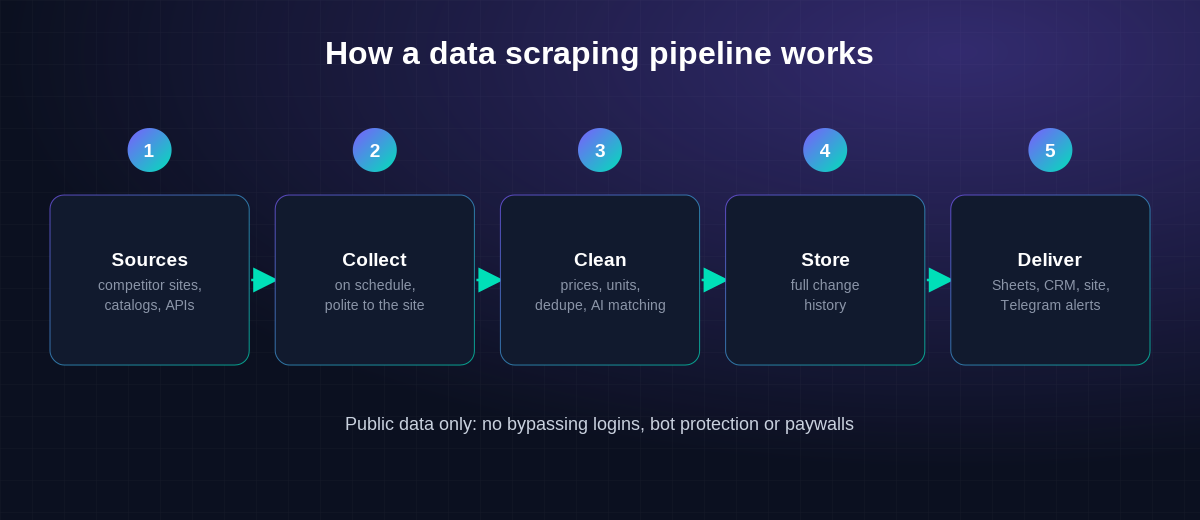
A scraper is a program that opens pages the way a person would and extracts the data. What separates a reliable data pipeline from a one-off script is everything after that:
- Collection. Regular pages via fast HTTP requests; sites that load data with JavaScript via a headless browser. If a site offers a public API or a feed (XML, CSV), we use that instead — it's more reliable and gentler on the site.
- Cleanup and normalization. Prices are converted to one format and currency, units are unified, duplicates removed. Products from different stores are matched by SKU, barcode or name.
- AI for the hard cases. When every store names products differently ("iPhone 16 128GB Black" vs "Apple iPhone 16 smartphone, 128 GB, black"), a language model handles matching and spec parsing. The same goes for classification, translation and short summaries.
- Storage and history. Every version of the data is stored, so you can see how a price changed over the month.
- Export and alerts. Google Sheets, Excel, a database, CRM, an import file for your store, or a Telegram message when something important changes.
Legal and ethical scraping
I only collect publicly available data — what any visitor can see without logging in. I don't bypass logins, paywalls or bot protection, and I don't collect personal data about private individuals. I keep the load on source sites minimal: delays between requests, off-peak schedules, caching. If a site offers an official API or a partner feed, I'll suggest using it. Before we start, we discuss how you'll use the data: republishing someone else's descriptions and photos on your site may infringe copyright, while price monitoring doesn't have that issue.
Example projects
| Task | Result |
|---|---|
| Price monitoring for 300 products across 5 competitors | A daily sheet "my product — competitor prices — difference" and an alert when a price drops |
| Importing a supplier catalog (2,000 items) | An import file for OpenCart, WooCommerce or Shopify with specs and images, daily stock updates |
| New tenders and job posts by keyword | A Telegram message for every new matching listing |
| Checking your own prices on marketplaces | A report of mismatches between your site, the marketplace and your accounting system |
Pricing
| Package | What's included | Price | Timeline |
|---|---|---|---|
| One-time export | 1 site, data in Excel or Google Sheets | from $150 | 2–3 days |
| Regular monitoring | up to 5 sites, schedule, history, Telegram alerts | from $400 | 1–2 weeks |
| Data collection system | dozens of sources, AI product matching, database, CRM or website integration | from $1,000 | 2–3 weeks |
Maintenance starts at $50/month. Source sites change their layout from time to time and the scraper needs an update. With maintenance, I find out before you do: monitoring alerts me as soon as data stops coming in.
If the collected data should trigger actions — create tasks, send reports, update prices on your site — see business process automation.
FAQ
How much does web scraping cost?
A one-time export from one site starts at $150. Regular monitoring of up to 5 sites with alerts starts at $400. Scraper maintenance starts at $50/month.
Is it legal to scrape competitor websites?
Collecting publicly available data such as prices for market analysis is common practice. I don't bypass logins or protection, don't collect personal data and keep the load on sites low. Reusing scraped texts and images on your own site may infringe copyright — we discuss this upfront.
What happens when a source site changes?
The scraper may stop collecting data. Monitoring flags it immediately, and with maintenance I usually fix the scraper within 1–2 business days.
Where can the data be delivered?
Google Sheets, Excel, CSV, a database, your CRM, an import file for your online store, or Telegram messages.
How often can the data be updated?
Anywhere from weekly to every few minutes — it depends on the task and on how much load is acceptable for the source site.
Let’s talk about your project
Describe the task in a couple of sentences — I reply within one business day. Free and no obligation.
Telegram Discuss a project