The three metrics and thresholds
| Metric | What it measures | Good | Poor |
|---|---|---|---|
| LCP — Largest Contentful Paint | when the largest above-the-fold element renders | ≤ 2.5 s | > 4 s |
| INP — Interaction to Next Paint | delay between a user action and the page’s visual response | ≤ 200 ms | > 500 ms |
| CLS — Cumulative Layout Shift | how much content shifts while loading | ≤ 0.1 | > 0.25 |
INP replaced FID in 2024. Google assesses field data from real users (the 75th percentile over 28 days), so what matters is speed on ordinary phones, not your developer laptop.
How to measure
- PageSpeed Insights — field data (with enough traffic) and a lab test.
- Search Console → Core Web Vitals — which page groups need work.
- Chrome DevTools → Performance — which element is the LCP and which script blocks input.
A real fix: the kriatiz.com homepage
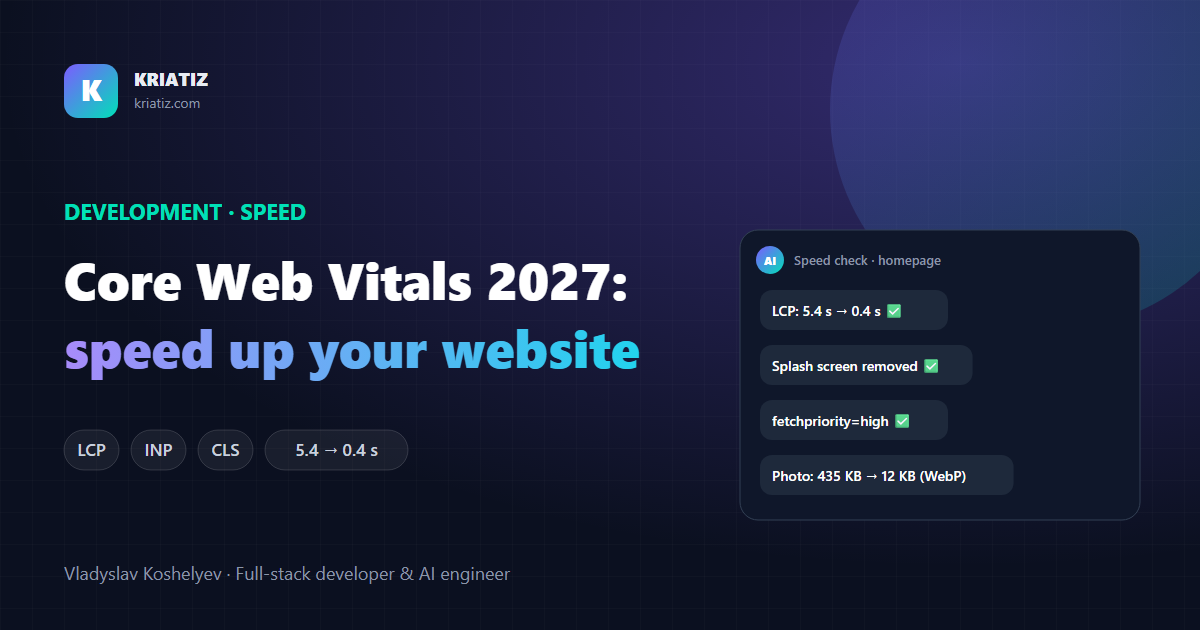
This site’s homepage had an LCP of 5.4 seconds — “poor” by Google’s standards. Two causes: a “Loading…” splash screen that covered the page for up to 4 seconds, and a 435 KB PNG photo above the fold that was the LCP element. We removed the splash, converted the photo to WebP in two sizes (12 and 22 KB) with srcset, explicit width/height and fetchpriority="high". Measured LCP afterwards: 0.4 seconds.
<img src="/img/photo-640.webp"
     srcset="/img/photo-640.webp 640w, /img/photo-960.webp 960w"
     sizes="(max-width: 900px) 90vw, 420px"
     width="640" height="640" fetchpriority="high" alt="…">
Common culprits
- LCP: heavy hero images, splash screens and sliders, render-blocking fonts and CSS, slow servers,
loading="lazy"on the hero image. - INP: heavy JavaScript (trackers, widgets, chats), long tasks in event handlers, huge DOMs.
- CLS: images and embeds without dimensions, banners and cookie notices that push content, late-loading fonts.
Checklist
- WebP/AVIF images at the right size, with width and height.
- No splash screens or sliders above the fold.
- Hero image with
fetchpriority="high", never lazy. - Third-party scripts deferred or loaded on interaction.
- Server caching, compression and a CDN for static files.
- Re-check PageSpeed Insights after every notable change.
Need a faster site? It’s part of SEO and website maintenance.
FAQ
Does site speed affect Google rankings?
Yes — Core Web Vitals are part of Google’s page experience signals. Relevance still comes first, but a faster site wins ties and converts better.
What are good Core Web Vitals values?
LCP ≤ 2.5 s, INP ≤ 200 ms and CLS ≤ 0.1 at the 75th percentile of real users.
What replaced FID?
Since 2024 Google uses INP, which accounts for the latency of all interactions on a page, not just the first one.
Let’s talk about your project
Describe the task in a couple of sentences — I reply within one business day. Free and no obligation.
Telegram Discuss a project