Who it’s for
- Healthcare: dental offices, clinics, med spas, veterinary practices.
- Beauty: salons, barbershops, nail studios, spas.
- Services: auto repair, device repair, cleaning companies.
- Education & fitness: schools, tutors, studios, personal trainers.
The tell-tale sign: your front desk spends the day answering “how much is it?”, “anything free on Saturday?” and “where are you located?”, while messages that arrive in the evening wait until morning — and some of those people book with a competitor instead.
What an AI receptionist does
- Answers questions about services, pricing, preparation, location and parking — from your knowledge base, not the open internet.
- Books appointments: checks availability, offers options, reserves the slot and confirms.
- Reschedules and cancels on request.
- Sends reminders a day and a few hours before the visit — fewer no-shows.
- Qualifies inquiries and hands staff a ready-made summary.
- Collects reviews after the visit and asks for a Google rating.
- Speaks the customer’s language and understands voice messages.
How it works
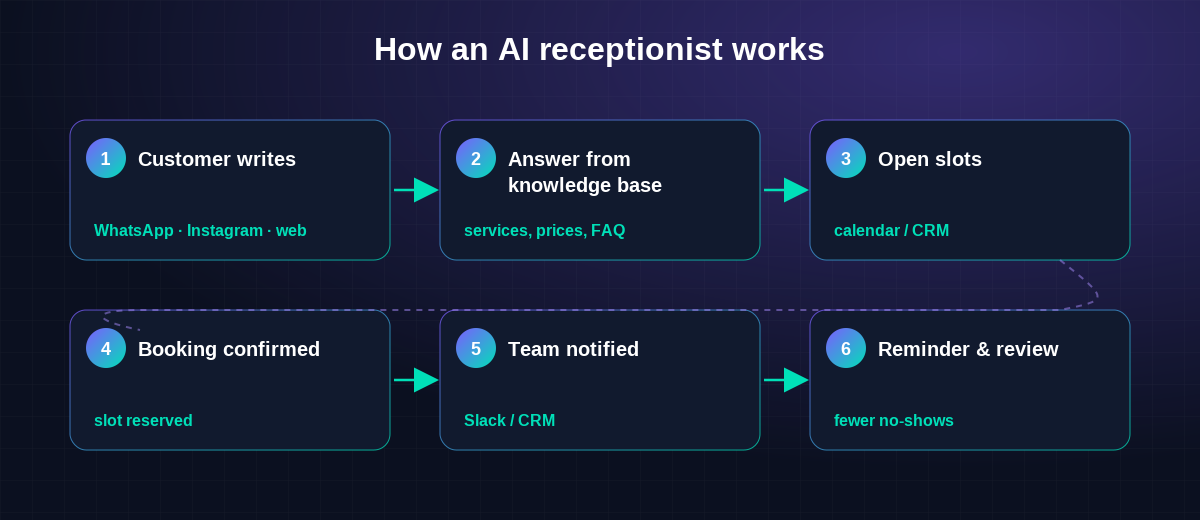
- The customer messages you on WhatsApp, Instagram, Telegram or your website chat.
- The AI finds the answer in your knowledge base.
- It checks your schedule in your booking system or Google Calendar and offers open slots.
- It books the slot and sends a confirmation with your address.
- It notifies your team via Slack, Telegram or your CRM.
- It reminds the customer before the visit and asks for a review after.
It connects to what you already use — Google Calendar, Cal.com, a CRM such as HubSpot, or a booking system with an API. No API? The AI passes the request to staff, who confirm the time.
What a conversation looks like
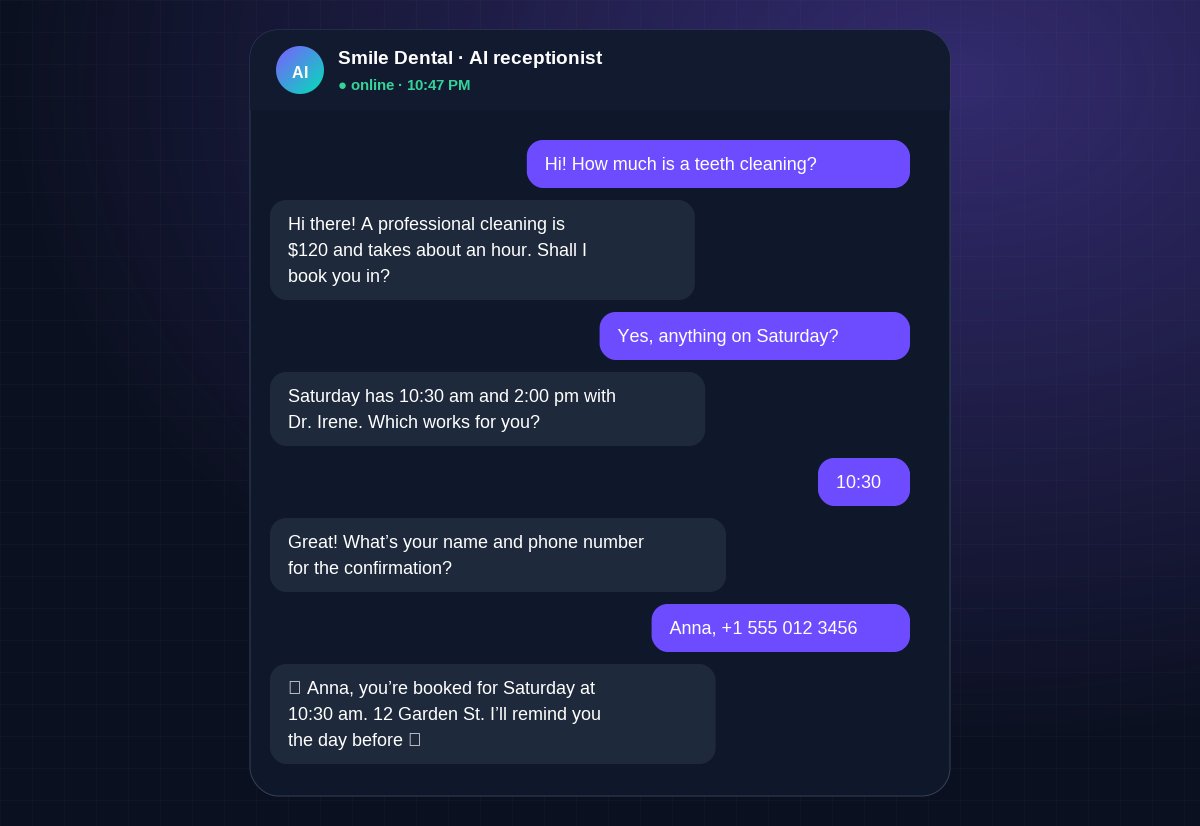
Notice that it doesn’t just answer — it steers toward a booking: clarifies the service, proposes a specific time and asks for contact details. That’s what turns chats into visits.
What an AI receptionist must not do
- No promises beyond the knowledge base — no invented discounts or guarantees. If it doesn’t know, it says so and loops in a human.
- No “verbal” payments — deposits go through a payment link.
- Escalates complaints, conflicts and unusual requests to staff.
- Handles data carefully: minimal personal data, stored on your side, business APIs that don’t train on your data. Healthcare providers should also check local rules such as HIPAA or GDPR.
Cost and payback
| Option | Includes | Price | Timeline |
|---|---|---|---|
| FAQ assistant | answers questions, forwards leads | from $500 | 1 week |
| AI receptionist | + calendar booking, rescheduling, reminders | $1,000–2,000 | 2–3 weeks |
| Multi-location | + several channels and branches, reviews, analytics | from $2,000 | 3–5 weeks |
Monthly: model usage is typically $10–50 depending on volume, plus hosting from $5. More on what drives cost: How much does an AI chatbot cost?
- Count the inquiries that arrive after hours and how many never get a timely reply.
- Multiply by your average visit value.
- Add the staff time spent on repetitive answers and reminders.
If the AI wins back even a few customers a month who would otherwise have gone elsewhere, it usually pays for itself within the first months.
Launch plan: 3 weeks
- Week 1 — knowledge base. Services, prices, durations, staff, booking and cancellation policy, FAQ. Template in the PDF above.
- Week 2 — build and integrate. Calendar or CRM, channels, staff notifications; test on real customer questions.
- Week 3 — go live and monitor. Start with one channel, review conversations for two weeks, then add the rest.
Need a bot for your business? See AI chatbot development for business: pricing from $500, 1–3 week delivery, ready-made scenarios by industry.
FAQ
Will an AI receptionist replace my front-desk staff?
No. It handles repetitive questions, booking and reminders, and works nights and weekends. Complex cases and decisions stay with people.
Which booking systems does it work with?
Google Calendar, Cal.com, CRMs such as HubSpot, and booking systems that offer an API. Without an API, it forwards requests to staff.
How much does an AI receptionist cost?
An FAQ assistant starts at $500; a receptionist with calendar booking and reminders costs $1,000–2,000, plus $10–50 a month for model usage.
Can it give medical advice?
It shouldn’t. It explains services and preparation and turns symptom questions into a consultation booking.
Let’s talk about your project
Describe the task in a couple of sentences — I reply within one business day. Free and no obligation.
Telegram Discuss a project